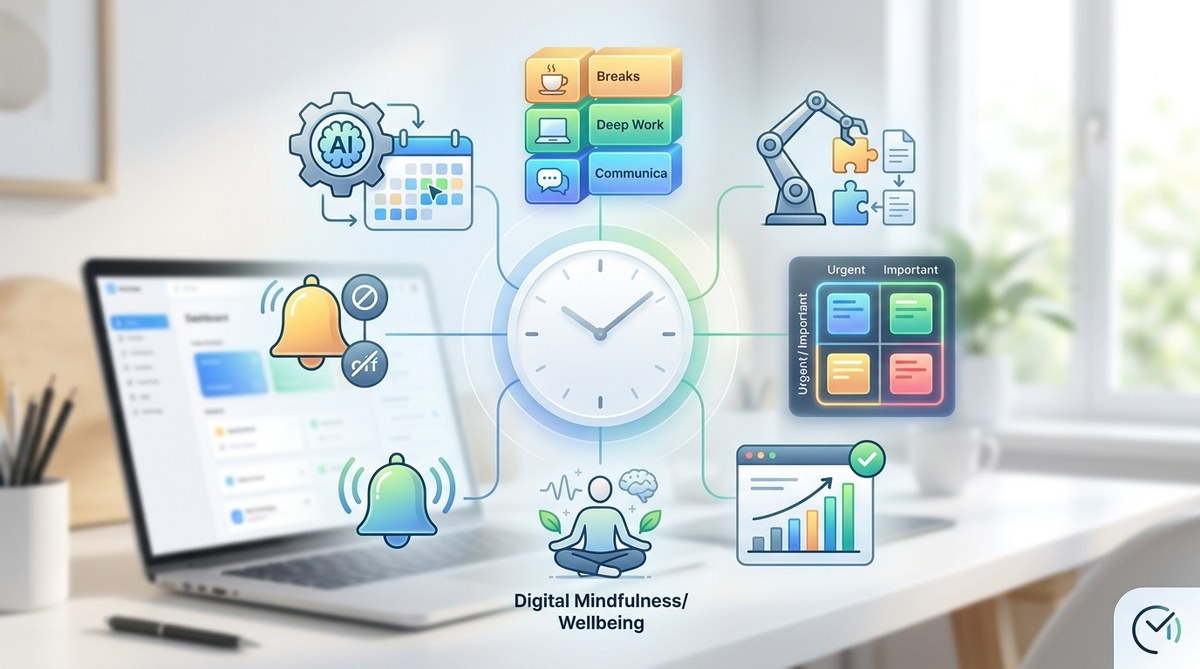
Between the laundry, the doorbell, and the siren call of your couch, working from home in 2026 is a test of willpower. You are not alone if you feel like your day vanishes into meetings, notifications, and half finished tasks. The trick is not to work more hours. The trick is to work with intention. Remote workers who stay on top of their game use a small set of repeatable tactics that protect their focus and respect their energy. These are not theoretical ideas. These are the same methods that freelancers and distributed teams rely on every day to hit deadlines without burning out. Whether you are new to remote work or a seasoned home office veteran, the seven strategies below will help you take control of your calendar.
Time management for remote workers in 2026 is less about rigid schedules and more about intentional energy matching, digital boundary setting, and automation. The seven tricks in this guide help you protect deep work, reduce decision fatigue, and build a rhythm that fits your life instead of fighting against it.
Why Standard Time Management Advice Falls Short at Home
The typical productivity advice assumes a controlled office environment. You have a manager nearby, a fixed lunch hour, and a door that closes. Remote work flips all of that. Your kitchen is thirty steps away. Your pet needs attention. Slack messages arrive at 8:00 PM. Traditional methods like the Pomodoro Technique or Eisenhower Matrix still have value, but they need adaptation. Remote workers must also manage isolation, asynchronous communication, and the blur between work and personal life.
“The biggest mistake remote workers make is treating their home like a branch office. It is not. You need a system that accounts for the flexibility and the chaos of being at home.” – Maria K., senior team lead at a fully remote SaaS company
A rigid 9-to-5 schedule often backfires when you live where you work. Instead, the most effective remote workers adopt flexible routines that bend around their natural energy peaks and valleys. Let’s walk through the seven specific tricks that make this possible.
The 7 Time Management Tricks That Actually Work in 2026
1. Time Block Your Energy Peaks, Not Your Clock Hours
Most people schedule tasks by the hour without considering how they feel during those hours. This is a mistake. Your brain operates in cycles. For most people, focus peaks in the late morning and dips after lunch. Remote workers in 2026 use time blocking based on energy levels instead of arbitrary start times.
Here is how to apply this today:
- Track your energy for three days. Note when you feel alert and when you feel sluggish.
- Reserve your peak window for deep work. No meetings, no email, no Slack.
- Use the low energy windows for admin tasks, email sorting, or light research.
If you want to build a system around this concept, check out strategies for effective time management with AI tools that can help you map your energy patterns automatically.
2. The Two Task Rule for Daily Focus
Multitasking is a lie. Every time you switch between tasks, your brain pays a switching cost that eats minutes. Remote workers who get things done use the two task rule each day. Before you close your laptop at night, pick exactly two outcomes for tomorrow. Not five. Not ten. Two.
Write them down. When tomorrow starts, do not open email or Slack until those two tasks are complete. This method removes decision fatigue and forces prioritization. If you struggle to choose which tasks matter most, read about smart strategies to prioritize tasks and maximize your workday in 2026.
3. Build a Shutdown Ritual That Signals “Work Is Over”
Remote work never truly ends if you let it. Your laptop sits on the desk. Your work phone buzzes after dinner. Without a commute to separate work from home, you need a deliberate shutdown ritual. This is a short sequence of actions that tells your brain the workday is done.
A good shutdown ritual includes three steps:
- Close all browser tabs and applications.
- Write down the two tasks for tomorrow on a sticky note or in a notes app.
- Physically close your laptop and move it out of sight.
This takes less than five minutes but has a powerful effect on your ability to relax. For more ideas on building healthy boundaries, see top digital habits to transform your workday and enhance focus.
4. Use the 80/20 Rule on Your Task List Every Week
The Pareto Principle applies directly to remote work. Twenty percent of your tasks produce eighty percent of your results. The challenge is identifying that twenty percent. At the start of each week, review your task list and circle the three tasks that will move your projects forward the most.
Everything else can wait, be delegated, or be automated. This is especially important for freelancers who wear many hats. You cannot do it all. Focus on the work that pays the bills and builds your reputation. If automation sounds like a path to more free time, take a look at boost your productivity by automating routine tasks with modern digital tools.
5. Schedule Breaks Like You Schedule Meetings
Skipping lunch or working through the afternoon is not a badge of honor. It is a recipe for a 3:00 PM crash. Remote workers who maintain steady energy schedule short breaks with the same seriousness as client calls. Use a timer if you need to. Step away from the screen. Walk around the block. Stretch. Do anything that is not work.
A simple break schedule looks like this:
| Work Period | Break Length | Activity Example |
|---|---|---|
| 90 minutes | 15 minutes | Walk, stretch, get water |
| 90 minutes | 15 minutes | Light household task |
| 60 minutes | 30 minutes | Lunch away from desk |
| 90 minutes | End of day | Shutdown ritual |
This table shows a sample rhythm, but you can adjust based on your energy patterns. The key is to treat breaks as non negotiable.
6. Set Communication Windows Instead of Always Being Available
The expectation of instant response is one of the biggest productivity killers for remote workers. When you are always on, you never get deep work done. Set specific windows for checking email and Slack. For example, check messages at 10:00 AM, 1:00 PM, and 4:00 PM. Outside those windows, close the apps.
Let your team or clients know your response windows. Most people respect boundaries once they are clear. If you manage a team, this practice also models healthy behavior for others. To learn how to structure your entire day around this concept, read about optimizing your daily schedule with AI powered time blocking techniques.
7. Review Your Week Every Friday for Fifteen Minutes
The last trick is the one that ties everything together. Every Friday afternoon, spend fifteen minutes reviewing your week. Ask yourself three questions:
- What worked well this week?
- What felt like a waste of time?
- What will I change next week?
This weekly review helps you catch patterns. Maybe you notice that Tuesday afternoons are always unproductive because of back to back meetings. Maybe you realize that checking email first thing in the morning derails your focus. Small adjustments add up over time. This habit alone can transform your productivity within a month.
Common Time Management Mistakes Remote Workers Make
Even with the best tricks, it is easy to fall into traps. Here are the most common mistakes remote workers make and how to avoid them:
- Working through lunch every day. This leads to an afternoon energy crash and lower quality output.
- Keeping work apps on your phone. Notifications blur the line between work and rest.
- Saying yes to every meeting. Too many meetings fragment your day and kill deep work.
- Checking email first thing. Email pulls you into reactive mode before you set your own priorities.
- Not using a separate workspace. Working from your bed or couch makes it harder to switch off.
Avoid these pitfalls and the seven tricks will work even better.
How to Choose the Right Time Management Method for Your Role
Not every trick works for every person. A freelance graphic designer has different needs than a remote customer support agent. Here is a table to help you match tricks to your situation:
| Role Type | Best Trick to Start With | Why It Helps |
|---|---|---|
| Freelancer / Solopreneur | Two task rule | Reduces overwhelm from wearing many hats |
| Remote team member | Communication windows | Protects deep work from constant messages |
| Manager / Team lead | Weekly review | Helps spot team wide patterns and bottlenecks |
| Creative professional | Energy based time blocking | Aligns creative work with peak focus hours |
| Customer support | Scheduled breaks | Prevents burnout from high volume interactions |
Pick the one that feels most relevant to your current struggle. Master it before adding another.
Building a System That Lasts Beyond 2026
Trends change. Tools come and go. But the core principles of time management for remote workers remain stable. Protect your focus. Respect your energy. Set clear boundaries. Review your system regularly.
If you want to build a complete productivity workflow, consider combining these tricks with a modern scheduling tool. For a deeper look at how to reclaim hours each week, see how to reclaim 10 hours a week with AI scheduling in 2026. Automation can handle the repetitive parts of your day so you can focus on the work that matters.
Your First Step Toward Better Time Management
Pick one trick from this list and try it tomorrow. Not all seven. Just one. Write down the two most important tasks for your day. Or set a communication window. Or schedule a real lunch break. Small changes compound into lasting habits.
You do not need to overhaul your entire routine overnight. The remote workers who manage their time well did not get there by making huge changes all at once. They built their systems one small adjustment at a time. Start today. See how it feels. Adjust again next week. That is the real secret.