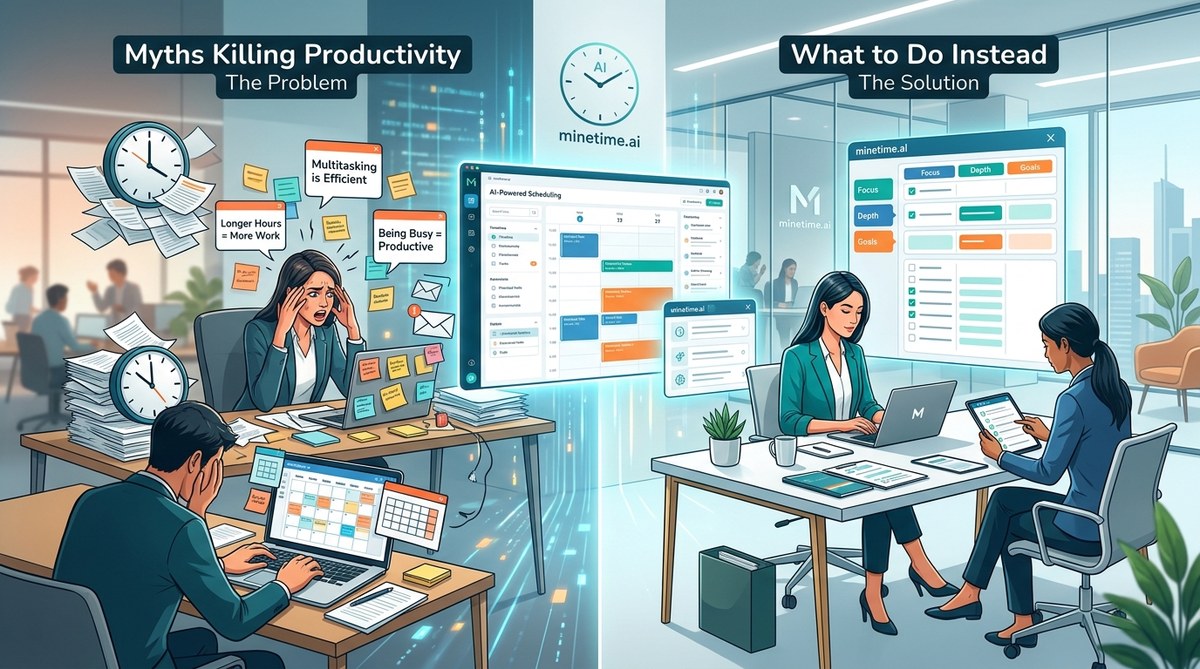
You have read all the productivity hacks. You have tried waking up at 5 AM. You have color-coded your calendar and installed three different to-do apps. Yet somehow, at the end of the day, you still feel like you are running on a treadmill that never stops. The culprit? You are probably operating under a handful of time management myths that sound logical in theory but backfire in practice. These myths steal your energy, waste your hours, and leave you frustrated. Let’s pull them apart one by one and replace them with something that actually works.
Most popular time management advice is built on myths that do more harm than good. Believing you must be busy to be productive leads to burnout, not results. Multitasking ruins focus instead of saving time. A perfect routine ignores real life, and trying to do everything alone drains your energy. By swapping these five myths with simple, human-friendly strategies, you can reclaim hours each week without working harder.
The Myth That Keeps You Busy But Unproductive
“I am so busy” has become a badge of honor. We wear it like a medal. But busyness is not the same as productivity. You can fill your entire day with small tasks, meetings, and email replies and still accomplish nothing meaningful. This time management myth tricks you into thinking that if you are moving, you are making progress.
What is really happening: When you prioritize busywork, you crowd out the deep, focused work that actually moves the needle. You check boxes, but you do not build anything lasting. The solution is not to do more; it is to do fewer things that matter.
Instead of chasing busyness, try this:
- At the start of each week, write down the three most important outcomes you need to achieve.
- Protect two hours of uninterrupted time each day for those outcomes.
- Let the small stuff wait. It will still be there tomorrow.
Why Multitasking Is a Lie
Think you can answer emails while listening to a meeting and also drafting a report? Your brain is not built for that. What you call multitasking is actually task switching, and it costs you up to 40% of your productive time. Each time you jump between tasks, your brain needs a warm-up period to refocus. Over a day, those warm-up moments add up to serious lost hours.
The reality: Single-tasking is the real superpower. When you focus on one thing at a time, you finish faster and with better quality. This is especially true for complex work like writing, coding, or planning a strategy.
A simple way to break the habit:
- Use a timer to work on a single task for 25 minutes.
- Turn off notifications on your phone and computer.
- After the timer rings, take a 5 minute break.
- Repeat. This rhythm trains your brain to stay on one track.
The Perfect Routine Trap
Many productivity gurus promise that a flawless morning routine will transform your life. Wake up at 5 AM, meditate, journal, exercise, hydrate, read. Then your day will be perfect. This time management myth sets you up for failure because life is messy. A sick kid, a late meeting, or just a bad night of sleep can derail the perfect plan. When you miss one step, you feel like a failure and give up on the whole day.
What works better: Build a flexible, forgiving structure. You do not need a perfect morning; you need a reliable starting point that can bend when life happens. For example, a simple two-step morning habit (drink water and review your top priority) is more sustainable than a twelve step ritual.
As productivity expert Dr. Alanna Ross puts it: “Consistency beats perfection every time. A so-so routine you stick with for six months outperforms a flawless routine you abandon after three days.”
Why You Should Stop Trying to Do Everything Yourself
Another sneaky time management myth is that you must personally handle every task to ensure quality. This belief keeps you overloaded and resentful. Whether you are a student delegating group project responsibilities or a manager assigning tasks to your team, letting go is essential. You cannot scale your time by working harder. You can only scale it by trusting others.
The cost of doing it all: You become the bottleneck. Deadlines slip, your energy drains, and you have no room for strategic thinking. The irony is that the people who most need to delegate are often the worst at it because they believe no one else can do it as well.
Start by listing everything you do in a week. Highlight the tasks that only you can do. Then, for the rest, find someone else to take them over. If you work alone, consider automation tools or outsourcing small pieces. Platforms like Minetime AI can help you automate scheduling and free up mental space.
The Finish Line Fallacy
There is no finish line. You will never reach a day when your inbox is empty, your to do list is zero, and you have nothing left to do. Yet many of us operate as if that magical day exists. We push harder, sleep less, and sacrifice relationships trying to “get ahead.” This time management myth creates chronic stress because the goalpost keeps moving.
The healthier mindset: Accept that work is infinite and your time is finite. Your goal is not to finish everything; it is to make meaningful progress on what matters most. When you stop chasing completion, you can focus on impact. You also protect your health and happiness.
Try this shift:
- Each evening, write down what you finished, not what you didn’t.
- Reward yourself for stopping at a reasonable hour.
- Remember that the most productive people are the ones who stop working at a sustainable time.
Myth vs. Reality: A Simple Comparison
Here is a table that captures the five myths and the truth you can apply starting today.
| Myth | Reality |
|---|---|
| Being busy means you are productive | Focus on outcomes, not activity |
| Multitasking saves time | Single-tasking finishes tasks faster |
| A perfect routine guarantees success | Flexible, consistent habits win |
| You must do everything yourself | Delegation and automation multiply your time |
| There is a finish line to productivity | Progress, not completion, is the goal |
How to Replace These Myths With Real Productivity
Changing your habits does not require a total overhaul. Small, intentional steps can break the grip of these time management myths. Try this simple process:
- Identify one myth that you lean on most. Which one feels familiar right now?
- Notice the cost. How is that myth wasting your time or energy? Write it down.
- Pick one replacement action from the sections above. For example, if you multitask often, commit to a single 25 minute focus block tomorrow.
- Track the result. Did you feel less stressed? Did you finish more? Use that evidence to reinforce the new habit.
- Repeat with the next myth after a week. You do not have to fix everything at once.
What to Do Instead: Habits That Actually Work
Here are a handful of proven strategies to replace the old myths. Pick two and try them for a week.
- Prioritize one demanding task before lunch, when your energy is highest.
- Use a simple notebook or a digital tool to capture all ideas and tasks so your brain can relax.
- Schedule regular breaks to walk, stretch, or breathe. Your brain needs downtime to stay sharp.
- Review your week every Friday. Ask: “What drained my time? What fueled my progress?” Adjust accordingly.
If you want to take it further, consider using smart strategies to prioritize tasks and maximize your workday that align with these principles. Many digital tools today can help you automate the busywork so you can focus on what matters.
Your New Productivity Mindset in 2026
You do not need to be a productivity machine. You need to be a human who works smarter, rests better, and stops falling for time management myths that are barely disguised traps. The goal is not to cram more into each hour. The goal is to spend your hours on things that feel meaningful and leave you with energy for the rest of your life.
Next time you catch yourself thinking “I have to do it all” or “I need to be busy all day,” pause. Remember that the most effective time managers are not the ones who do the most. They are the ones who know what to ignore. Let yourself ignore the myths, and watch your productivity actually grow.