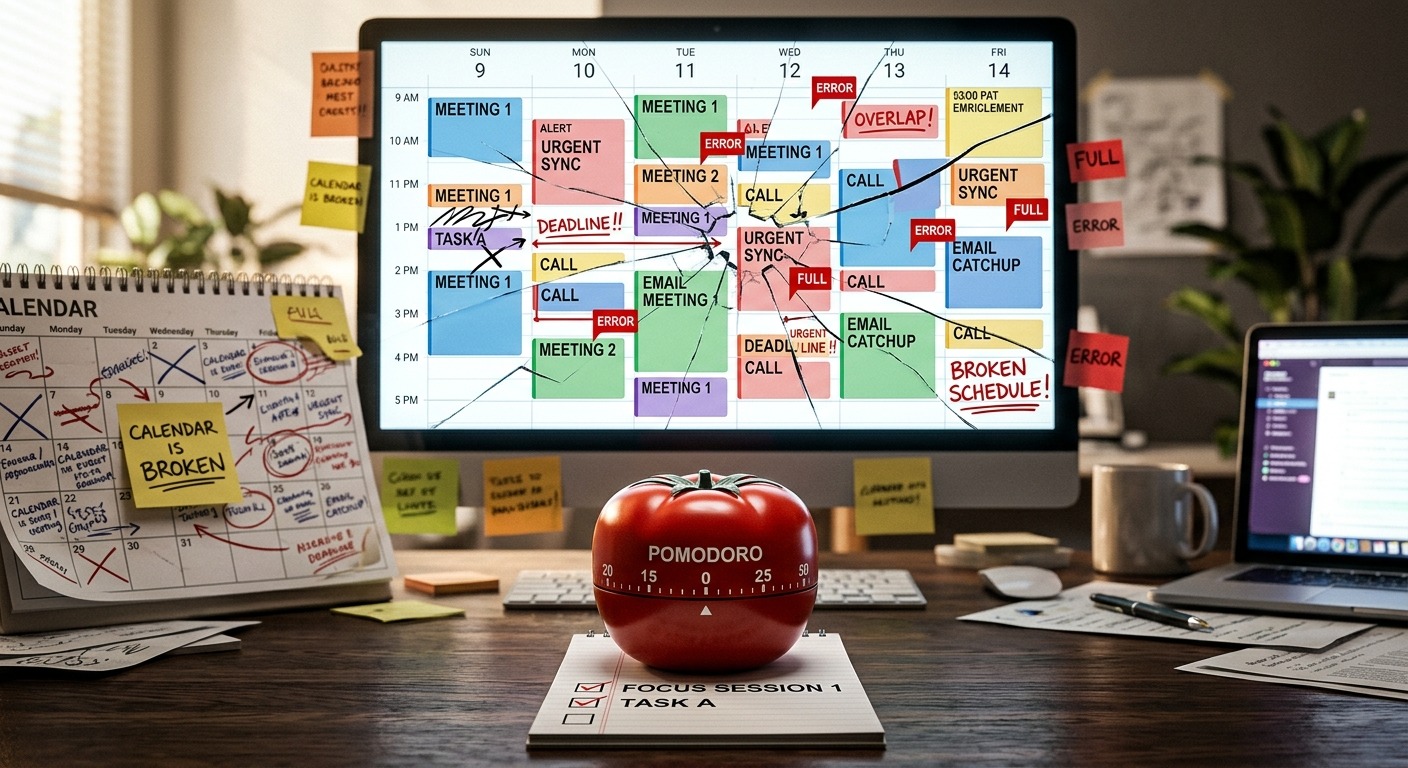
You set the timer. Twenty-five minutes, no distractions. Then Outlook pings. Then someone sends a “brief sync” invite for 10 AM. Then your calendar fills up before you have finished your first coffee. By 9:45, the focus block you planned is already gone, and the timer you opened never even got a chance to run. This is not a time management problem. This is a calendar architecture problem, and it is the reason so many professionals quietly shelve a technique that, on its own, genuinely works.
The Core Problem
The Pomodoro Technique is structurally sound and cognitively well-grounded. It needs unbroken 25-minute windows to function, and most professional calendars never provide them. AI scheduling tools that actively protect those focus blocks are not a luxury feature. They are the missing prerequisite that makes any timer-based method actually survivable in a real workplace. The timer is not the problem. The calendar is.
What the Pomodoro Technique Actually Does
Francesco Cirillo developed the Pomodoro Technique in the late 1980s while studying and struggling to stay on task. The concept is almost aggressively simple. You pick one task, set a timer for 25 minutes, and work on nothing else until the timer rings. Then you take a five-minute break. After four of these cycles, you take a longer break of fifteen to thirty minutes. Each 25-minute block is called a “pomodoro,” after the tomato-shaped kitchen timer Cirillo used at the time.
The genius of it is not the tomato. It is the commitment to a single unit of attention. Working with a pomodoro timer gives you a concrete, audible boundary that transforms an abstract goal like “do some work” into a specific, bounded sprint. The time constraint reduces the psychological weight of starting. You are not committing to a full afternoon of effort. You are committing to 25 minutes. Most people find they can begin almost anything for 25 minutes.
The method also addresses one of the most destructive productivity killers: task-switching. Decades of cognitive research show that switching between tasks carries measurable costs, including time lost and increased error rates. Each interruption does not just pause your work. It fragments your attention in a way that takes far longer to recover from than the interruption itself lasted. Pomodoro sessions protect against this by design. Every notification you ignore during a session is a fragmentation you avoided.
Why Professionals Quietly Give Up on It
Here is the pattern. A professional discovers the Pomodoro Technique during a particularly chaotic week. They try it. The first session feels surprisingly good, focused and purposeful. They finish the morning with a sense of actual progress, which has become rare enough to feel remarkable. They decide to keep using it.
Then Monday comes around. There is a team standup at 9:30. A client check-in at 10:15. An alignment call at 11. By the time they clear their morning obligations, the optimal window for deep focus has closed. They try to squeeze a pomodoro into the gap before lunch. The gap is 18 minutes. The timer needs 25. They abandon the session halfway through, which defeats the psychological architecture of the method entirely.
This repeats for a few days. The professional concludes that the technique does not work for them. What has actually happened is that their calendar has no structural space for 25-minute uninterrupted windows. The Pomodoro Technique did not fail. Their schedule did.
The Invisible Architecture of a Meeting-Heavy Calendar
Calendar clutter does not feel like a structural problem while it is building. It accumulates gradually. A recurring weekly sync that started as a genuine necessity gets kept long after the project it served is finished. An optional standup gets attended out of social obligation. A 45-minute meeting gets scheduled at 10:00, which effectively kills the morning block on both sides of it by leaving fragments too short for deep work.
The result is what productivity researchers sometimes call calendar fragmentation. Your day looks full, but the actual units of usable attention time are tiny. Fifteen minutes here. Twenty minutes there. None of those windows are long enough for a real pomodoro session. None of them approach the depth of concentration that meaningful work requires. You end the day feeling busy but unproductive, which is one of the most draining feelings a professional can experience repeatedly.
Notification ecosystems compound this. Even on days with lighter meeting loads, the average knowledge worker receives enough pings, alerts, and channel messages to dismantle any focus block they manage to carve out. The interruptions are not accidental. They are built into the tools most teams use by default. Calendar chaos and notification noise are two sides of the same problem, and a 25-minute timer cannot defeat both of them alone.
How AI Calendar Tools Actively Defend Your Focus Time
AI calendar tools approach this problem differently from traditional time-blocking. You can manually block time on a calendar, but those blocks are passive. They get moved. They get overwritten by meeting invites. They disappear under the pressure of “any chance you are free this afternoon?” and then they never come back.
AI scheduling tools make focus blocks active. They analyze your existing calendar commitments, identify where your energy and attention are likely to be strongest, and claim those windows before meeting invites can fill them. When a new meeting request arrives, the AI routes it to available slots that do not break existing focus periods. The deep work windows are treated as non-negotiable by default rather than optional by default, which is exactly the reversal most professionals need.
Some tools go further by learning your patterns over time. If your focus tends to peak in the late morning, the system protects that window consistently rather than requiring you to manually rebuild your blocking strategy every week. It also factors in buffer time. A back-to-back meeting schedule does not just steal focus hours. It steals transition time, those few minutes of mental settling between tasks that your brain genuinely needs before it can produce useful output. AI scheduling tools that build in buffer time dramatically improve the quality of whatever work time remains.
Building a Pomodoro-Ready Schedule with AI Assistance
The practical approach combines the Pomodoro method with AI-driven calendar protection as a single system rather than treating them as separate tools. The first move is getting your AI scheduling tool to block recurring deep work windows, ideally two or three sessions per day, positioned at your cognitive peak times. These blocks should be long enough to complete at least two full pomodoro cycles without interruption, meaning a minimum of sixty minutes with a short break built in.
The next piece is having the AI buffer every meeting by at least ten to fifteen minutes on both sides. This prevents the fragmentation that turns your day into an obstacle course of unusable gaps. Thirty-minute transitions make your schedule breathable. Five-minute transitions make it brutal.
The third piece is pairing your focus blocks with automatic do-not-disturb settings, not as something you remember to toggle on, but as a built-in condition of the block itself. The timer should not compete with a notification ecosystem. It should operate inside a window that has already been swept clean. Done consistently, this gives you a calendar that actively makes pomodoro sessions possible instead of passively letting them get destroyed. The technique handles the focus. The AI handles the defending.
Fixing the Foundation, Not Just the Timer
The Pomodoro Technique has lasted four decades because it correctly identifies something true about human attention: focused work in bounded intervals produces better output than open-ended multitasking spread across an unstructured day. That insight has not aged. What has changed is the environment professionals are trying to apply it in.
Modern workplaces are built to fragment time. Meetings multiply. Notifications compete for attention. The calendar fills from the outside in, leaving the owner of that calendar with whatever scraps remain. A timer, regardless of how solid the method behind it, cannot survive that environment without structural support.
AI scheduling tools that actively protect focus blocks are not a productivity trend to test and then abandon. They are the infrastructure layer that any timer-based method requires before it can function reliably in real workplace conditions. The Pomodoro Technique is ready to work. The question worth asking is whether your calendar is finally ready to let it.