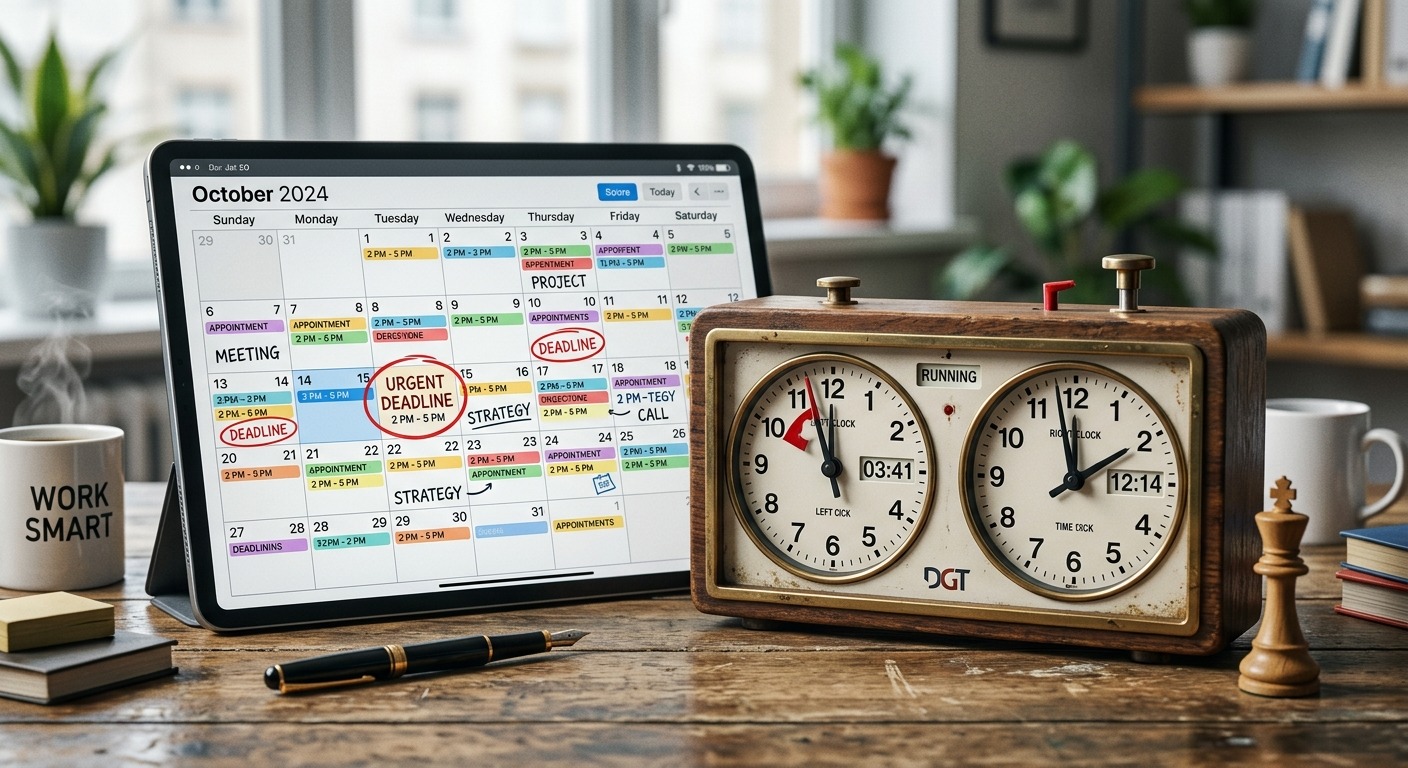
Somewhere between your third meeting and your fourth, the morning disappeared. Nobody took it. Nobody is even tracking where it went. By noon, the calendar shows a day packed with collaboration, and yet nothing has been built, written, or finished. The calendar looks productive. The calendar has no idea.
This is the quiet absurdity at the center of modern meeting culture. Hours evaporate without any built-in mechanism to hold individuals accountable for how much time they actually consumed. There is no alarm. There is no personal counter ticking toward zero. The meeting ends when the conversation runs dry, or when the next calendar block forces a reluctant goodbye. Time is treated as a shared, inexhaustible resource. It is not.
The Clock You’re Not Running
Most professionals track where their money goes down to the cent. Almost none track where their hours go with the same precision. A calendar full of meetings feels like productivity in motion. But without clear accountability for how each minute is used, that fullness is an illusion. The real cost is not the meetings themselves. It is the sustained attention, creative energy, and deep work that quietly vanish inside them, one unaccountable hour at a time.
The Meetings That Never Have to End
Think about the structural reality of a typical work meeting. There is a block of time, a list of people, and maybe an agenda. Nobody owns the clock.
That last detail matters more than it sounds. In a meeting with eight people, each person’s contribution to the total time spent is completely invisible. One person might dominate 40 minutes of a 60-minute call. Another might barely speak. Both appear on the calendar as having attended the same one-hour meeting. Neither feels the weight of the time they consumed, because no individual clock was running.
This is meeting culture’s core design flaw. When no personal timer is ticking, time becomes a shared resource without an owner. Nobody rations it. Nobody feels the pressure to wrap up. The conversation continues until it reaches a natural stopping point, which can be minutes or an eternity past when the actual work was done.
And so the bloat compounds. A 30-minute sync becomes 45 minutes, then an hour. The next meeting starts late because the previous one ended late. Context switches shred the sustained attention needed to do anything hard. By the end of the day, the calendar is fully accounted for. The actual work is not.
How Chess Treats Every Second as Non-Negotiable
Competitive chess players understand something that most professionals never learn. Time is not a backdrop. It is a resource. It is finite. And it is personal.
In a serious chess match, each player has their own clock. You make a move, you hit the button, and the burden of time shifts to your opponent. Your clock only ticks when it is your turn to think. When your personal allocation runs out, you lose. Not because your position was bad, but because your time was gone.
That constraint changes the quality of every decision. There is no padding. There is no comfortable drift. You cannot spend seven minutes on a routine move when the critical position is still four turns ahead. Each second carries weight because each second is finite and personal.
You can feel that kind of pressure directly by playing a few rounds against an AI chess clock, which makes the experience of personal time budgets visceral in a way that a shared calendar never does. The clock ticking down against your name alone is a different experience from watching a group meeting timer count toward its scheduled end. One belongs to everyone. The other belongs only to you.
That difference is worth sitting with. What would it feel like if every meeting had an individual clock running against each participant? If talking longer meant your personal budget ran down?
The Quiet Drain of an Unmetered Calendar
Without personal time accountability, calendars fill up by default. They become containers for other people’s priorities rather than deliberate maps of your own. Patterns captured in national time use research consistently reveal that workers underestimate how much of their week goes to meetings and reactive communication, and overestimate how much goes to focused, independent creation. That gap between perception and reality is exactly where the chess clock problem lives.
Here is what it looks like in a typical knowledge worker’s week:
- Meeting creep: A 30-minute sync stretches to 50 minutes because there is no structural pressure to wrap up before the conversation naturally exhausts itself.
- Back-to-back cognitive damage: Consecutive meetings with no buffer leave the brain mid-thought and mid-context, unable to shift into the sustained focus that hard work requires.
- Invitation acceptance bias: When time feels like an abstract quantity rather than a finite personal budget, it is psychologically easy to accept one more meeting that costs an hour of your most valuable attention.
- Calendar as status signal: A packed schedule signals busyness, and busyness is culturally read as productivity, even when actual output is minimal. The calendar rewards the appearance of productivity, not the thing itself.
None of this is a personal failing. It is a structural consequence of a scheduling system that was never designed to make individuals accountable for the time they consume.
What AI Scheduling Changes About the Equation
AI scheduling tools do not just move appointments around more efficiently. The better ones treat your calendar as a time budget and help you manage it the way a chess player manages their clock: deliberately, with full visibility into what has already been spent and what remains available.
That shift in framing changes the questions being asked. A passive calendar accepts whatever gets booked into it. An AI-assisted time budget asks different questions. How much focused time do you actually need this week to move your most important work forward? Which of these meetings could become an async update instead? Where is your presence genuinely required, and where are you just showing up out of habit?
Traditional Calendar vs. AI-Assisted Time Budget
| Dimension | Traditional Calendar | AI-Assisted Time Budget |
|---|---|---|
| Time ownership | Shared, invisible, untracked | Personal, visible, deliberate |
| Meeting length | Runs until conversation stops | Bounded by agenda and energy cost |
| Focus time | Claimed by whoever books first | Protected and scheduled proactively |
| Scheduling decisions | Reactive and passive | Intentional and pattern-aware |
| Weekly time audit | Almost never happens | Built into the workflow |
The difference is not just efficiency. It is agency. When your calendar is a time budget, you are the chess player, not just a piece being moved across the board.
Building Your Personal Time Budget with AI
The practical question is how to actually build this kind of calendar. Not as a rigid, brittle time-blocking system that collapses at the first unexpected meeting request, but as a durable structure that holds its shape under pressure.
Start with an honest audit of where your hours currently go. Not a vague impression, but actual numbers. Pull the last two or three weeks of your calendar and categorize every block. Count the meeting hours. Count the transition gaps. Count the blocks you genuinely used for focused, uninterrupted work. The gap between what you assumed was happening and what the data shows is almost always instructive.
From there, AI scheduling tools can help you design proactively rather than react defensively:
- Anchor your deepest work first: Block focus time before anyone else can claim it. Treat that block as a committed obligation, not a placeholder. AI tools can identify your peak energy windows from calendar history and protect them automatically, before the week fills up around them.
- Trim default meeting lengths: Switching defaults from 30 to 25 minutes and from 60 to 50 minutes builds transition time into the structure itself, and creates natural pressure to use each meeting with intention rather than drift.
- Use async as the first option: Before accepting an invite, ask whether the same outcome could come from a shared document, a short recorded walkthrough, or a threaded discussion. AI tools that analyze recurring meeting patterns can flag which standing meetings consistently produce nothing that could not have been a message.
- Run a weekly time audit: Treat your hours the way you treat your budget. Where did the time go? Which meetings earned their cost in actual decisions or forward movement? AI-assisted scheduling tools can surface these patterns automatically, identifying the recurring drains you would miss reviewing it manually.
The Timer Was Always Running
The chess clock exists because thoughtful people realized that unlimited time does not produce better decisions. It produces worse ones. Time pressure does not reduce quality. It concentrates attention and eliminates the comfortable drift that feels productive but generates nothing.
Your calendar, as it likely exists today, has no chess clock. Time enters it freely and exits invisibly. Nobody in your meetings is accountable for how much of the shared resource they consumed, and nobody is auditing what got left on the board at the end of the week.
That is a design problem, not a personal failing. And it is a solvable one.
AI scheduling tools are applying the logic of the chess clock to professional calendars. They track patterns, flag waste, and protect the time you need before other people’s priorities fill the board. The calendar stops being a passive container for appointments and becomes an active record of how you chose to spend a finite, non-renewable resource.
The question worth asking is not whether you are busy. Your calendar will always look full. The question is whether you are playing your own game on your own clock, or just sitting across the table while the minutes tick down on someone else’s terms.