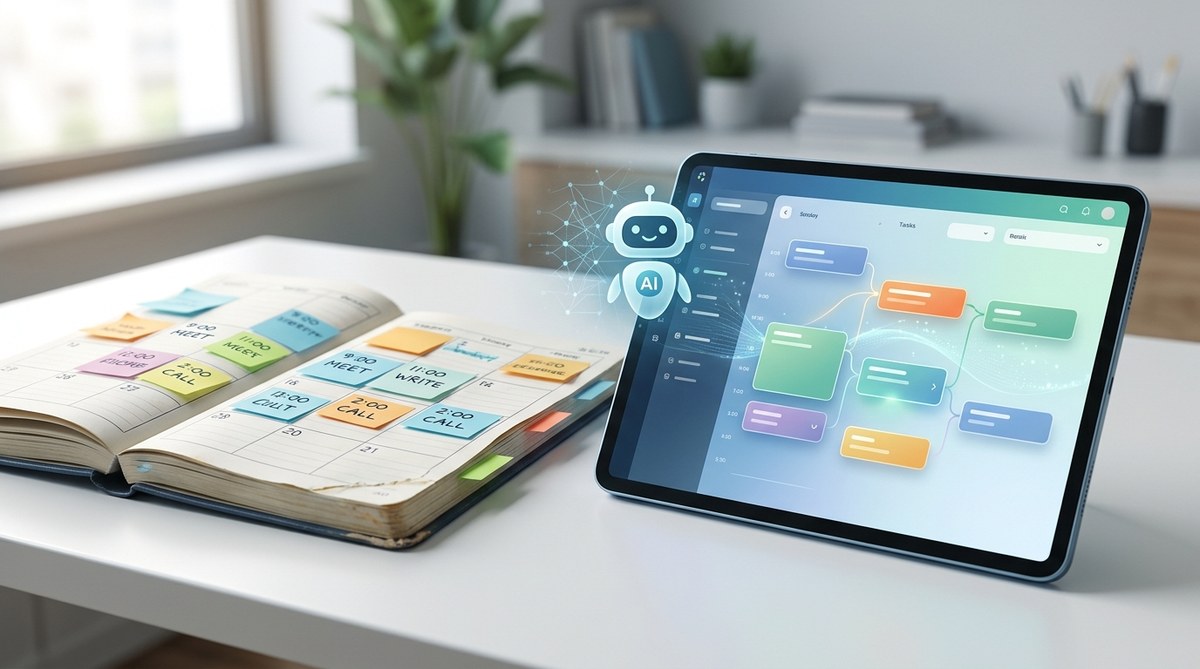
Your calendar used to rule your life. You blocked off every hour, color coded every task, and promised yourself this time it would stick. Then Monday hit. A meeting ran long. Your kid got sick. An urgent client request landed in your inbox at 3 p.m. By Tuesday your beautiful time blocks were a graveyard of good intentions. You are not alone. Traditional time blocking works great in theory and falls apart the moment reality shows up. That is why a growing number of busy professionals, freelancers, and productivity enthusiasts are turning to AI time management instead. The shift is not about working harder. It is about letting smart technology handle the guesswork so you can focus on what actually matters.
AI time management moves beyond rigid scheduling by learning your work patterns, priorities, and energy levels. Instead of forcing tasks into fixed blocks, it creates an adaptive plan that shifts with disruptions. The result is less stress, fewer rescheduled tasks, and more deep work completed each week. This guide shows you exactly how it works and how to start using it today.
The Problem with Rigid Time Blocking
Time blocking is not dead. But it is sick. The method asks you to predict your entire day with perfect accuracy. You assign each task a slot and then hope nothing goes wrong. Something always goes wrong.
Here is what happens when life interrupts a rigid schedule:
- You miss one block and the whole domino chain collapses.
- You spend more time rebuilding the plan than doing the work.
- You feel guilty and frustrated, even when the disruption was out of your control.
- You start avoiding the calendar altogether because it feels like a cage.
The real issue is not your discipline. It is that static plans cannot handle a dynamic world. You need a system that bends without breaking.
What Makes AI Time Management Different
AI time management flips the script. Instead of you building a schedule and fighting to keep it, the AI builds the schedule and adjusts it automatically. It learns from your behavior. It knows when you focus best. It understands which tasks actually matter and which ones can slide.
Think of it as a personal assistant who never sleeps. It watches your calendar, tracks your energy patterns, and reshuffles priorities the moment something changes. You do not have to micromanage the plan. You just show up and do the work.
This is not science fiction. In 2026, tools like Minetime AI make adaptive scheduling available to anyone with a smartphone and a calendar. The technology has matured, and the results are measurable.
How AI Scheduling Actually Works
Let us break down the process into five clear steps. This is the engine behind every good AI time management tool.
-
Data collection and pattern recognition. The AI scans your calendar history, task completion rates, and meeting patterns. It notes when you typically focus, when you procrastinate, and what types of work drain your energy. The more you use it, the smarter it gets.
-
Priority scoring and task ranking. Every task on your list gets a weight based on urgency, importance, and your personal goals. The AI does not treat all tasks equally. It surfaces the work that moves the needle and deprioritizes busywork.
-
Adaptive scheduling. The system places tasks into open time slots based on your energy levels and the task requirements. Deep work goes into your peak focus hours. Routine tasks fill lower energy windows. The schedule is built around you, not the other way around.
-
Real time disruption handling. When a meeting changes or an urgent request arrives, the AI reshuffles automatically. It finds new homes for displaced tasks without you lifting a finger. Your plan stays alive instead of dying on impact.
-
Continuous feedback loop. The AI tracks what you actually completed versus what was planned. It adjusts future schedules based on your real performance. Over time, the predictions become eerily accurate.
If you want to see this in action, check out this guide on how to let AI take over your scheduling so you can focus on deep work.
Benefits of an AI Powered Schedule
Switching to AI time management is not just about convenience. It changes how you relate to your day.
- Less decision fatigue. You stop wasting mental energy on “what should I do next?” The AI presents your next best action.
- More deep work. The system protects your focus time by automatically blocking distractions and low value tasks.
- Lower stress levels. When disruptions happen, you do not panic. You trust the system to adapt.
- Better work life boundaries. The AI respects your off hours and makes sure tasks fit into your available time instead of overflowing into evenings.
- Data driven improvements. You see patterns in your productivity you never noticed before. That knowledge helps you make smarter choices about how you spend your time.
Curious about the specific numbers? Read about how to reclaim 10 hours a week with AI scheduling in 2026.
Common Time Management Mistakes and How AI Fixes Them
| Mistake | Why It Hurts You | How AI Solves It |
|---|---|---|
| Overcommitting your calendar | You leave no buffer for delays or emergencies | AI automatically reserves buffer time between tasks |
| Prioritizing urgency over importance | You spend your day fighting fires instead of building | AI scores tasks by impact, not just deadline pressure |
| Ignoring your natural energy rhythms | You schedule creative work during your afternoon slump | AI maps tasks to your energy patterns based on past data |
| Trying to multitask | Your brain switches context and loses momentum | AI groups similar tasks together to reduce context switching |
| Forgetting to review and adjust | You repeat the same mistakes week after week | AI analyzes your completion rates and adjusts future plans |
The table above shows why most time management systems fail. The root cause is almost never laziness. It is a mismatch between the tool and how humans actually operate. AI bridges that gap.
If you want to dig deeper into why traditional approaches fall short, this article on why most time management systems fail and how AI fixes them lays it all out.
Expert Take on AI and Productivity
“The biggest myth in productivity is that more control leads to better results. In reality, rigid systems create resistance. The best schedule is one that breathes. AI lets you build a plan that adapts to your life instead of fighting it. That is why I recommend adaptive scheduling to every client I work with.”
Dr. Maya Chen, productivity researcher and author of Flow First
Dr. Chen hits on a key point. Control is not the goal. Flow is. When your schedule fights against reality, you spend your energy wrestling with the plan instead of doing meaningful work. AI removes that friction.
Getting Started with AI Time Management
You do not need a massive tech stack to get started. Most AI scheduling tools plug directly into your existing calendar. Google Calendar, Outlook, Apple Calendar they all work.
Here is a simple three step plan to start today.
Step one: Audit your current schedule. Spend three days tracking how you actually spend your time. Note when you feel focused and when you drag. This gives the AI a baseline to work from.
Step two: Choose a tool that fits your workflow. Some tools focus on calendars. Others integrate task management and project tracking. Pick one that matches how you work.
Step three: Give it two weeks of trust. The first few days will feel strange. You will want to override the AI and go back to your old habits. Resist that urge. Let the system learn. By day ten, you will see a noticeable difference in how your day flows.
For a deeper walkthrough, the guide on struggling with time here is how AI can build your ideal schedule covers the setup process in detail.
The Future of Work Is Adaptive
We are past the era of forcing square pegs into round holes. AI time management represents a fundamental shift in how we think about productivity. It is not about squeezing more into your day. It is about making sure the right things get done at the right time, with room for the unexpected.
The professionals who adopt this mindset early will have a serious advantage. They will spend less time managing their calendar and more time doing work that matters. They will feel less burned out and more in control, even when life gets messy.
If you are ready to stop fighting your schedule and start flowing with it, take a look at boost your daily productivity with AI powered task prioritization. It is a great next step on this journey.
Your time is too valuable to waste on a system that breaks every time life happens. Give yourself permission to try something smarter. Your calendar will thank you. And so will your brain.