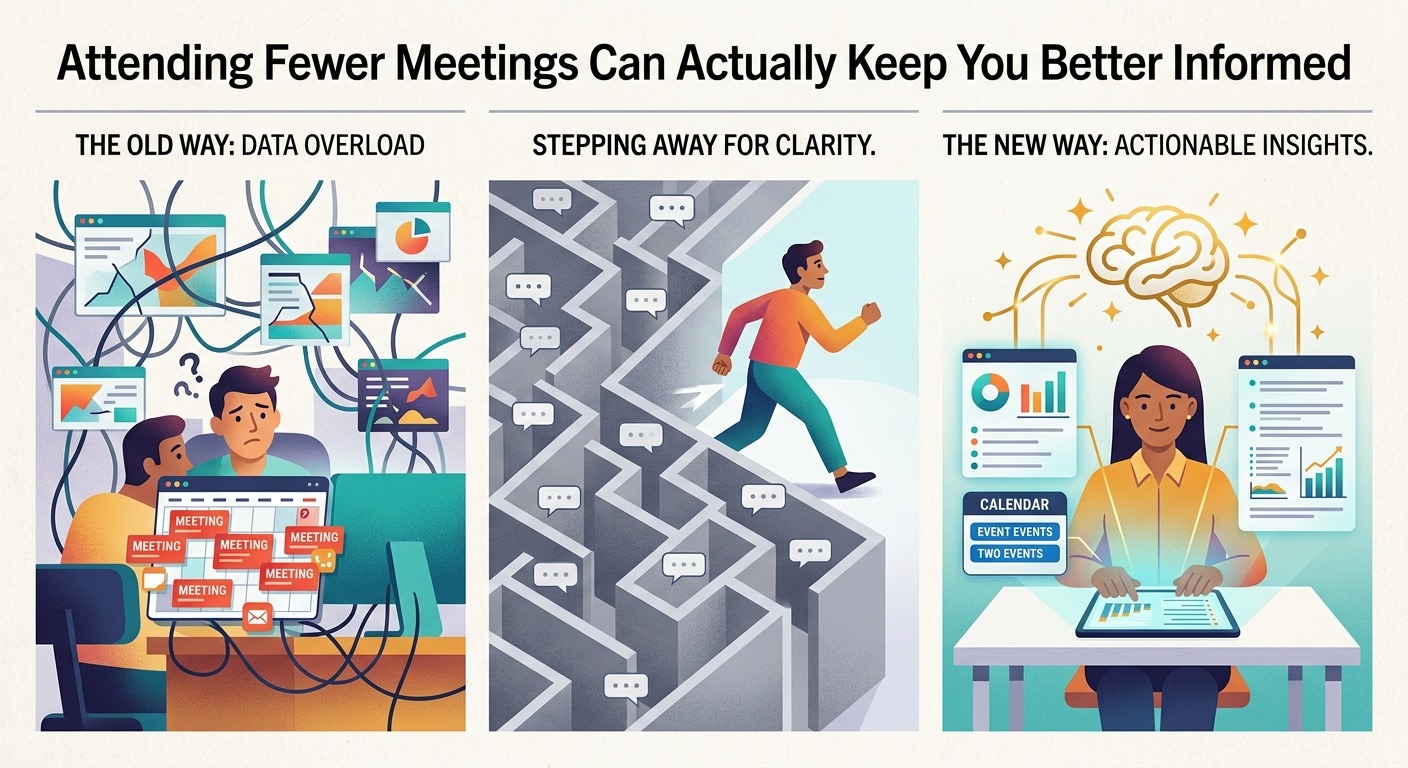
Your calendar looks like a game of Tetris, and you are losing. Back-to-back calls eat up the best hours of your day, leaving you exhausted, behind on actual work, and somehow still unsure what was decided in the third meeting of the afternoon. The cruel irony is that attending all those meetings was supposed to keep you in the loop. It is not working. What if the loop you are trying to stay in is actually easier to access from the outside?
The Async Advantage at a Glance
- Live attendance drains cognitive resources without guaranteeing better recall.
- Reading a transcript or summary takes a fraction of the time and produces stronger retention.
- Tools that convert recorded calls into scannable text make async catch-up genuinely fast.
- Most meetings fall into the “consumable later” category once you apply a simple decision rule.
- Selective attendance frees your peak focus hours for the work only you can do.
The Hidden Cost of Showing Up to Everything
There is a pervasive guilt around declining a meeting invitation. It feels like opting out of relevance. Saying no to a calendar invite can feel like announcing to the room that you do not care. But the cost of saying yes to everything is rarely calculated honestly.
Every hour spent in a meeting you did not need to attend is an hour stolen from focused work. It is also an hour your brain spent context-switching rather than building anything. Studies tracking knowledge worker habits consistently find that middle managers now spend more than half their working hours in meetings. That number has climbed steadily over the past decade.
Ask those same managers how much of that meeting time genuinely required their real-time presence, and you will hear a lot of uncomfortable pauses. The real issue is not the meetings themselves. It is the assumption that physical, or virtual, presence equals engagement. That assumption is worth challenging.
What Your Brain Is Actually Doing During Back-to-Back Calls
Sit through four one-hour meetings in a row. By the time the fourth one starts, your prefrontal cortex is running on fumes. Decision quality drops. Your ability to synthesize information slows. And your retention of anything said after the second meeting is shaky at best.
This is not a personal failing. It is neuroscience. The human brain is not built for continuous passive input across long stretches. It processes and consolidates information better with rest, reflection, and variety of input. Passive listening in a meeting, where you cannot control pace or rewind or annotate, is one of the least efficient modes of information absorption available to you.
Data from ongoing surveys on hybrid work culture, including annual research on how knowledge workers spend their time, consistently shows that back-to-back meetings correlate with elevated stress and reduced output quality. That is not a coincidence. Your brain is telling you the current system is broken, and it is right.
Reading a Summary Beats Sitting Through an Hour-Long Call
Here is the counterintuitive part. When you read a well-structured summary of what happened in a meeting, you often come away better informed than someone who attended live.
Why? A few reasons. Written summaries strip out the filler. They highlight decisions, action items, and unresolved questions. They are scannable. You can read at your own pace, stop to think, reread a confusing line, or jump to the section most relevant to your work. None of that is possible when you are stuck in a live call where the agenda is at someone else’s mercy.
Reading comprehension research has long shown that self-paced reading leads to better retention than passive listening at someone else’s tempo. When you control the pace of intake, you are more likely to flag things that do not make sense and commit key points to memory. Passive attendance in a meeting removes that control entirely.
And yes, the same logic applies to video recordings. Watching a two-hour recorded meeting at 1.5x speed is still a significant time commitment. Transcripts and written summaries are the real upgrade. They compress a 60-minute call into a five-minute read without sacrificing the substance.
Tools That Make Async Work Feel Effortless
The practical barrier people hit when they decide to go async is simple: how do you actually get the content from a meeting you did not attend? This used to require asking a colleague to write notes, which felt like burdening someone. Now it is largely automated.
Recording and transcription tools have matured significantly. If your team records calls on Zoom, Google Meet, or Teams, you can convert those recordings into full, searchable transcripts without lifting a finger. Zoom to text conversion, for example, turns a recorded call into a clean, readable document in minutes. From there, an AI summary tool distills that document into a focused brief covering decisions, open questions, and next steps. You go from a 60-minute call to a five-minute read.
The tools that support a reliable async-first workflow include:
- Auto-transcription: Built into many conferencing platforms or available as add-ons, these create searchable records of every spoken word.
- AI summarization: Tools that ingest long transcripts and produce concise decision logs and action item lists without any manual effort.
- Async video messaging: Short recorded updates that let teammates absorb context without scheduling a live meeting at all.
- Shared living notes: A single document updated after each call that becomes the team’s authoritative record of what happened and what comes next.
The combination of transcription and summarization is particularly powerful. You get the accuracy of the full transcript with the usability of a tight summary. You can search for your name or a specific project keyword and jump straight to the relevant section. No rewinding required.
Not All Meetings Are Created Equal
Going async does not mean becoming a hermit. Some meetings genuinely benefit from live presence. The trick is knowing which ones, and being honest about the rest.
Here is a decision framework for sorting your calendar. Work through it for every recurring invite on your schedule:
- Does the meeting require real-time input from you specifically? If your absence would cause the meeting to stall or produce a worse outcome, attend. If your presence is purely informational, opt out.
- Is there genuine discussion that cannot happen asynchronously? Brainstorms with tight deadlines, emotionally sensitive conversations, and high-stakes negotiations benefit from live interaction. Status updates, announcements, and read-outs do not.
- Are you there to speak or to listen? If you are attending purely as an audience member, a recording or summary serves the same purpose at a fraction of the cost to your day.
- Could you contribute more effectively by reviewing the output later? For large meetings with many stakeholders, your bandwidth is often better spent acting on the conclusions than observing how they were reached.
- Has this meeting recurred for longer than six months without a clear deliverable? That is a strong signal the meeting has become ritual rather than function. It belongs on the chopping block, not your calendar.
Apply this filter to your current calendar for one week. The number of meetings that survive the test may genuinely shift your perspective on what attendance actually means.
Your Time Back Is Not the Only Reward
There is a version of professional life where your calendar reflects your actual priorities. Where the hours that matter most to your output are protected from interruption. Where you attend meetings because you chose to, not because the invite appeared and obligation did the rest.
That version is not a fantasy. It is a system built on one honest reckoning: live attendance has a price, and that price is often higher than the information it delivers.
Most meetings deliver information. Information can travel through text. When you start treating meetings as content rather than as mandatory appointments, you stop measuring your engagement by seat time and start measuring it by actual comprehension and action taken.
The professionals who stay best informed are rarely the ones who attend the most meetings. They are the ones who have built reliable ways to absorb the content of those meetings on their own terms, at their own pace, in the windows of time that actually work for their brains.
Attending fewer meetings live does not mean fewer meetings absorbed. It means absorbing them better, faster, and with enough energy left over to actually do something with what you learned. That is the kind of informed that matters.