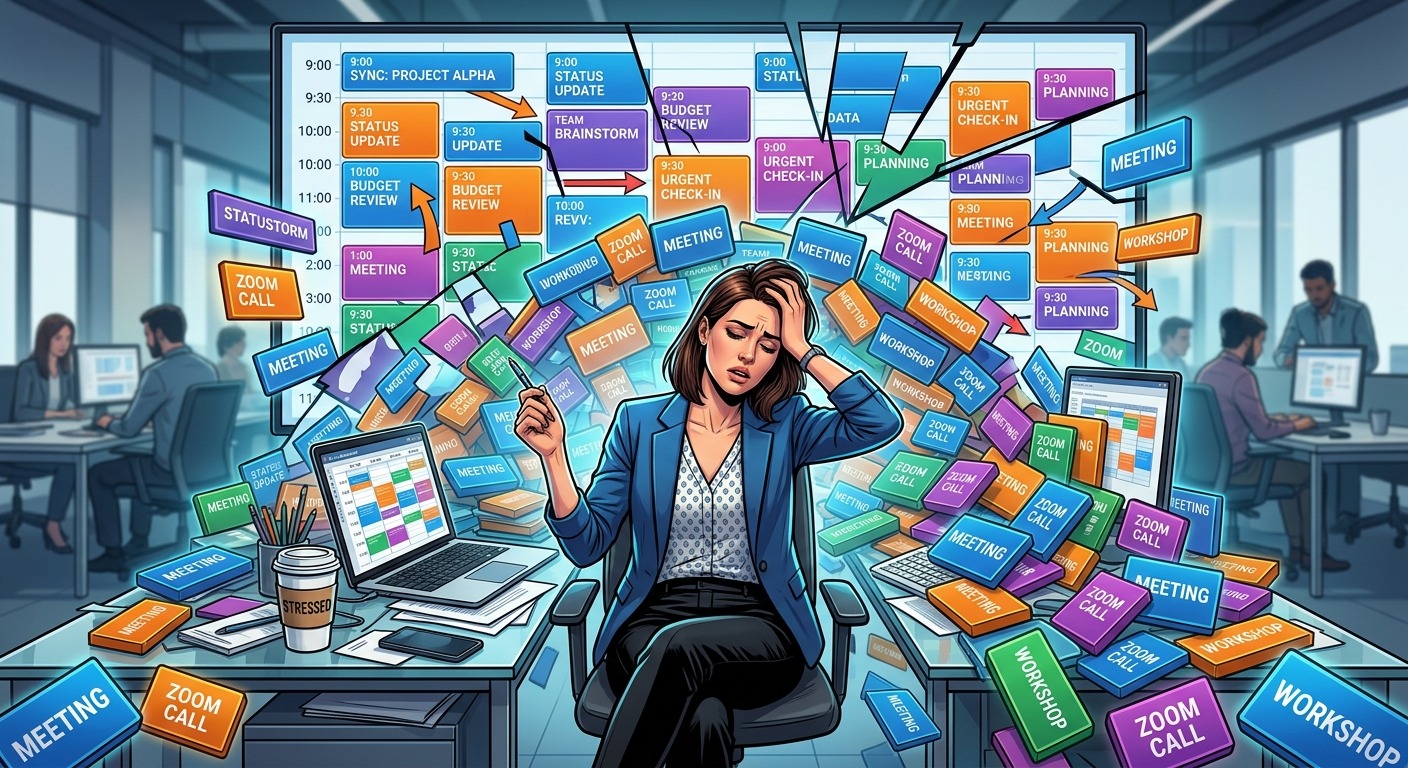
Your calendar fills up before Monday morning even arrives. Three invites have claimed slots before you open your laptop, and by noon you have spent four hours in meetings where your presence was optional at best. The standard prescription is to push back harder, block time more aggressively, or simply learn to say no. That advice is not entirely wrong, but it treats a structural problem as a personal one. The real issue is more fixable: nobody deliberately designed your calendar in the first place.
The Core Argument
Meeting overload is not a discipline failure. It is what happens when a calendar is left in its factory-default state, wide open and entirely passive. An unstructured calendar is not neutral territory. It is an open invitation. The fix is not willpower. It is design: grouping meetings into predictable blocks, treating async as the starting point, and protecting focus time the way you protect a client deadline.
Why the “Just Say No” Advice Always Falls Short
Telling professionals to simply decline meetings is a bit like telling someone with a leaky roof to just stop using buckets. The symptom gets managed for a week, but the underlying structure stays broken.
The reason this advice fails is that it requires constant, exhausting individual decisions. Every invite becomes a low-grade negotiation. Every declined meeting needs a reason, a rescheduling suggestion, or an awkward follow-up. Most people eventually give up and accept the invite because the social cost of saying no repeatedly feels higher than the time cost of attending.
This is not a character flaw. It is friction working exactly as it was designed to, and friction always wins unless you change the system that creates it.
A deliberately structured calendar removes most of those individual decisions before they arise. When your calendar has visible, consistent patterns, colleagues start to work around them. The ask shifts from “Can we grab thirty minutes sometime?” to “Are you available Thursday afternoon?” That single shift changes everything about how your week gets assembled.
What an Undesigned Calendar Actually Costs You
The cost of a fragmented calendar goes well beyond the hours spent inside meetings. Research on cognitive task-switching consistently shows that the brain takes meaningful time to reorient after each context shift. Moving from a meeting back into focused work is not instantaneous. It can take fifteen to twenty minutes before you recover the cognitive depth needed for complex thinking.
A typical day with five scattered meetings does not just consume five meeting-length blocks of time. It can effectively eliminate the possibility of deep work entirely, because the fragments between meetings are too short and too mentally disrupted to use productively.
This is the hidden cost that meeting tallies never capture. You might walk away from a Thursday thinking you had three hours free. In practice, those three hours were broken into four separate fragments, each too short to build any real momentum. The math of attention does not add up the way the clock does.
The Meeting Block Strategy That Reclaims Your Days
The most effective structural fix is also the simplest: stop letting meetings scatter randomly across available gaps, and start grouping them deliberately into contained windows.
Meeting blocks work by concentrating collaborative time into defined parts of the week. You choose, in advance, which portions of your calendar are available for meetings. Everything outside those windows is off-limits by default, not by case-by-case negotiation.
A common pattern is to designate Tuesday and Thursday afternoons as meeting windows, while Monday, Wednesday, and Friday mornings remain protected. This is not a rigid system. Life requires flexibility and priorities shift. But it creates a default structure that others learn to respect over time, simply because they can see it.
The psychological effect tends to be underestimated. When you know your mornings are protected, you stop dreading Monday. You arrive with a plan rather than a question mark. That sense of predictability is not a small thing. It is the difference between spending the week reactively and spending it with intent.
Async First: Changing the Default Before Scheduling Gets Involved
A significant portion of meetings exist because async communication was never seriously considered. Someone has a question, a status update, or a decision to surface, and the path of least resistance is to schedule a thirty-minute call.
Defaulting to async does not mean replacing all real-time collaboration. It means making meetings earn their place. Before scheduling anything, the honest question is whether this actually requires synchronous time at all.
Status updates rarely do. A brief recorded video, a well-structured message, or a shared document with comments can handle most of what gets wrapped in a meeting. Decisions with a single clear owner often do not need a group call to move forward. Brainstorming sometimes benefits from an async round first, giving people time to think independently before a focused live session.
The shift to async-first is partly cultural. It rarely happens overnight. But it tends to start with one person modeling the behavior consistently. When the team sees that async communication is responded to thoughtfully and promptly, the default gradually adjusts. You stop being the person who schedules a meeting for everything and start being the person whose messages actually move things forward.
Locking Down Focus Hours Before Anyone Else Can Claim Them
Protected focus time is not a luxury for senior leaders or creative professionals. It is the operating condition any knowledge worker needs to produce their best output.
The problem is that focus time does not protect itself. An empty calendar slot at 10 a.m. looks, to an outside observer, exactly like an available meeting slot. Without a structural signal that the time is already claimed, someone will claim it for you.
The types of work that genuinely require protected time include:
- Writing, drafting, and long-form thinking that requires sustained concentration to do well
- Strategic planning and complex decision-making that involve weighing real tradeoffs carefully
- Code, design, or analysis work where a single interruption can reset your mental state entirely
- Learning and skill development that builds slowly but disappears under constant meeting pressure
- Reading and synthesizing information to stay genuinely informed about your field
Blocking this time on your calendar and treating those blocks as real commitments is the most direct way to hold the line. A block labeled “Deep Work” or “Focus Time” communicates everything a meeting organizer needs to know. You do not owe anyone an elaborate explanation.
Reducing the Friction That Makes Scheduling a Time Sink
Even with a well-designed calendar, the coordination cost of scheduling individual meetings is real. Back-and-forth messages to find a mutually open slot can consume more time than the meeting itself, and they generate a low-grade stress that lingers throughout the day.
This is where the right tooling earns its keep. Connecting a smart meeting scheduler to your calendar automates the coordination layer entirely, letting others book directly into your pre-approved windows without the email dance. The cognitive benefit is not trivial. When the logistics of scheduling are handled automatically, your mental bandwidth stays available for the actual work of redesigning your calendar rather than managing its daily stream of requests.
The goal is to make the right meetings easy to book in the right slots, while making it structurally difficult for low-priority meetings to appear anywhere else. Automation handles that without requiring discipline or constant manual oversight. It is not a shortcut. It is what good systems design looks like in practice.
Measuring the Gap Between Default and Designed
The difference between an open calendar and a deliberately designed one is not just philosophical. It shows up in concrete, daily patterns across every dimension of how knowledge work actually gets done.
Open Calendar vs. Intentionally Designed Calendar
| Factor | Open Calendar | Designed Calendar |
|---|---|---|
| Meeting placement | Scattered unpredictably throughout the day and week | Grouped into defined, predictable windows |
| Deep work availability | Unpredictable and frequently absent | Protected in advance and reliably present |
| Response to new meeting requests | Requires constant individual negotiation | Structure communicates availability automatically |
| Default communication mode | Sync meetings as the first instinct | Async first, meetings used as the exception |
| Scheduling friction | High, managed manually via back-and-forth | Low, handled by tooling within predefined slots |
| Mental bandwidth at day’s end | Depleted by decisions and constant fragmentation | Preserved through structure and fewer context shifts |
Building a Calendar That Actually Serves the Work
Data from annual workplace trend research shows that time spent in meetings more than doubled between 2020 and 2022 for the average knowledge worker. Remote and hybrid work were supposed to bring more flexibility. In many cases they brought more surface area for interruptions instead, because the structural problem was never addressed.
A designed calendar does not mean a rigid one. You are not building a schedule that cannot bend. You are building a default state that protects what matters most and accommodates the unexpected in designated ways, not at random intervals throughout every day.
The meetings that genuinely need to happen will still happen. They will just happen in the slots you chose rather than the slots others defaulted to. The difference is whether your calendar reflects your priorities or reflects everyone else’s urgency.
The shift in mindset is the real change. A calendar is not a passive record of where time went. It is an active design tool for how you want to do your best work. The professionals who feel most in control of their weeks are not the ones who are best at saying no. They are the ones who stopped waiting for their time to be taken and started deciding, in advance, how it would be used.
That requires no rare personal trait. Just design.